Blogs
2026.03.25
Introduction to the characteristics of ETFE and key considerations in injection molding.
ETFE is a type of high-performance engineering plastic with a variety of distinctive properties.
This article introduces the characteristics of ETFE and key considerations for injection molding.
Please take a look.
What is ETFE?
ETFE (Ethylene Tetrafluoroethylene) is a thermoplastic fluoropolymer composed of ethylene and tetrafluoroethylene.
It provides excellent chemical and weather resistance comparable to PTFE, while also allowing injection molding like conventional thermoplastics, making it suitable for manufacturing precision components.
ETFE also offers excellent electrical insulation and strong resistance to outdoor degradation, making it widely used for electrical components, mechanical parts, and plastic components used in chemical environments.
Although ETFE has high heat resistance, it typically requires relatively high processing temperatures, so appropriate processing equipment and mold design are important to ensure stable production quality.
Key considerations in ETFE injection molding
The molding process tends to require high temperatures, and temperature control plays a critical role in determining product quality.
ETFE is one of the fluoropolymer materials that can be processed by injection molding. However, its molding temperature tends to fall within a high-temperature range, and precise temperature control directly affects product quality.
If the cylinder temperature is insufficient, the resin may not melt completely, which can lead to incomplete filling, short shots, and weld line defects.
On the other hand, excessively high temperatures may cause thermal degradation of the resin, gas generation, and surface defects.
Therefore, it is important to optimize the molding conditions according to the part design—such as thin-wall structures, ribs, and bosses—as well as the gate design.
Consideration should be given to melt flowability and filling balance, and countermeasures for thin-wall sections should be addressed from the design stage.
The flow characteristics of ETFE can vary significantly depending on molding conditions, and therefore maintaining filling balance becomes a challenge in thin-wall or fine-featured parts.
If the flow is insufficient, defects such as short shots at the flow end, sink marks, and uneven surface appearance may occur, and dimensional accuracy can become unstable.
To address these issues, it is effective to optimize gate location and runner design, thereby reducing flow distance, minimizing wall thickness differences, and avoiding sudden cross-section changes in the part design.
In addition, adjusting injection speed and holding pressure is important during the molding process. Maintaining pressure after cavity filling helps prevent material shortage and improves product quality.
Mold Corrosion Prevention
Since the gases generated during ETFE processing can be corrosive, appropriate measures must be taken to protect molds and processing equipment.
At our company, corrosion-resistant mold materials are used, and surface coatings are applied to the mold, helping to prevent corrosion and maintain mold durability during production.
Demolding performance is strongly influenced by the mold surface, so attention must be paid to potential demolding issues.
Although ETFE can be processed by injection molding, demolding issues may occur depending on the part geometry and mold surface condition.
Poor demolding can lead to defects such as deformation during part ejection, stress whitening, surface scratches, or cracking, which may reduce production yield. In particular, parts with fine features or undercuts tend to have higher demolding resistance, making stable production more difficult.
As a basic countermeasure, sufficient draft angle should be ensured in the mold design. In addition, optimizing ejector pin placement to avoid concentrated stress during ejection, and carefully selecting mold surface finish or texture, are also important.
If necessary, the use of mold release agents or mold surface treatments can also be considered to improve molding stability and process reproducibility.
Examples of ETFE injection molding at our company
Office automation equipment components
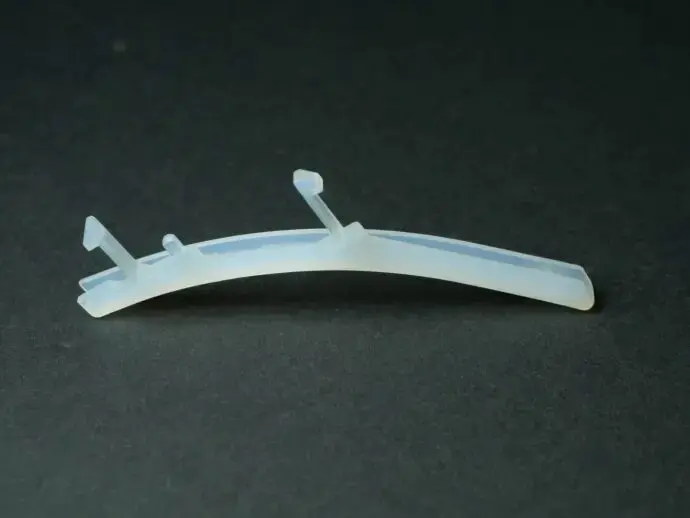
This product is made of ETFE material and has dimensions of 46 × 4 × 3 mm.
Thanks to its excellent chemical resistance, electrical insulation, and low friction properties, ETFE is often used for components such as transport pulleys in copiers and printers, particularly in the paper transport process from the fusing stage to the paper output stage.
Pulley for Office Automation Equipment
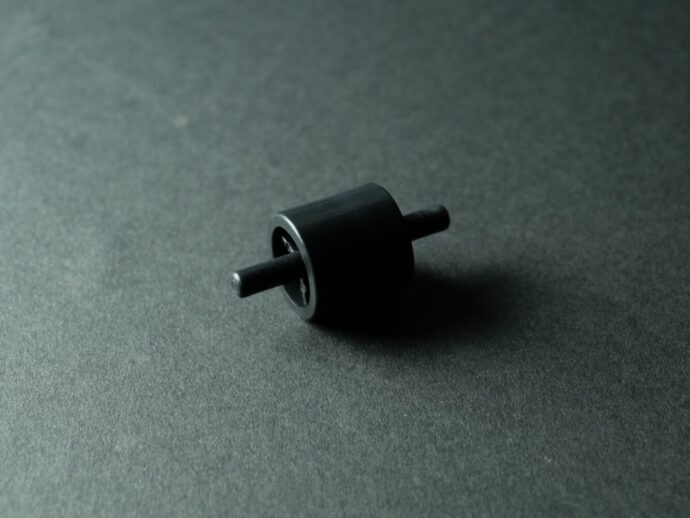
This product is a cylindrical component made of ETFE material, with dimensions of 12 × 12 × 25.9 mm.
It is used as a sliding component in a paper feeding mechanism, where high sliding performance is required. For this reason, ETFE was selected as the material.
During processing, a dedicated ventilation system is installed in the factory to handle generated gases, ensuring a safe working environment.
In addition, since ETFE can cause corrosion, high corrosion-resistant steel is used for the screw cylinder, and a protective coating is applied to the product surface area of the mold. Furthermore, the mold is disassembled after each production run for cleaning and anti-corrosion treatment, helping to maintain stable product quality.
Pulley for Office Automation Equipment
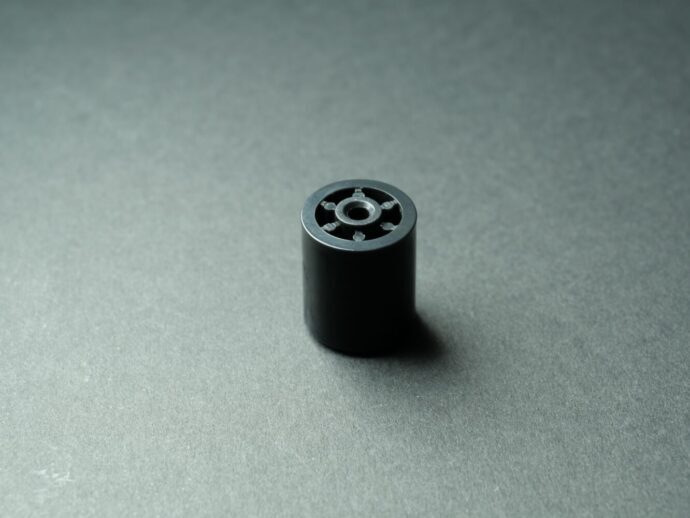
This product is a sliding component made of ETFE material, with dimensions of φ12 × 15 mm.It is used as a sliding part in a paper feeding mechanism, where high sliding performance is required. For this reason, ETFE was selected as the material.
During the manufacturing process, a dedicated ventilation system is installed in the factory to handle generated gases, ensuring a safe working environment.
In addition, to address the corrosive characteristics of ETFE, high corrosion-resistant steel is used for the screw cylinder, and a protective coating is applied to the mold cavity surface. Furthermore, the mold is disassembled after molding for cleaning and anti-corrosion treatment, helping maintain stable molding quality.
Trust us for high-quality ETFE injection molding
How was it? In this topic, we introduced the characteristics of ETFE and key points of injection molding. Juraron Industries Co., Ltd. has extensive experience in ETFE molding and can handle a production volume of 300,000 units per month. Please feel free to contact us.
About JURARON Group
JURARON Group, with its headquarters in Japan, has expanded its branches in Vietnam, Hong Kong, and China. We specialize in the development, production, and sale of precision components,primarily made using injection molding technology. In addition, we provide optical design services, lens injection molding,and the production and processing of ultra-precision molds and components.
Please visit our website for more detailed information about our products and services.