Blogs
2026.06.25
Introduction to the characteristics of PA and key considerations in injection molding.
PA (Polyamide), widely known as nylon, is an engineering plastic that combines excellent mechanical strength with outstanding wear resistance, making it a highly versatile material. It is often the top choice for metal-to-plastic substitution and has become an indispensable material in modern manufacturing. In this article, we will provide a detailed overview of PA’s unique characteristics, critical control points during injection molding, and practical application examples.
What is PA?
Amide-containing polymers
PA is a general term for polymers that repeatedly contain “amide bonds” within their molecular structure. Typical types include PA6 (nylon 6), which offers a well-balanced set of properties, and PA66 (nylon 6,6), which provides superior heat resistance and mechanical strength. These materials are among the oldest engineering plastics, and thanks to long-established and highly reliable performance data, they are widely used as key materials across various industrial fields.
High Versatility
Thanks to its outstanding properties, PA is highly valued as a metal substitute in applications ranging from small fastening components like bolts and nuts to large parts inside automotive engine compartments. As industrial digitalization accelerates and the demand for lightweight products grows, PA—with its excellent processability and high strength—is positioned as a key material that expands design flexibility
Key Features
Mechanical Properties and Impact Resistance
One of PA’s greatest advantages is its exceptional toughness, which enables it to withstand strong external impacts without cracking or breaking easily. Since it retains its toughness even in low-temperature environments, PA is well suited for structural components subjected to impact loads. Furthermore, the incorporation of fillers such as glass fibers can significantly enhance its stiffness
Wear Resistance and Self-Lubricating Properties
PA possesses inherent self-lubricating properties, giving the material a low coefficient of friction and reducing the risk of damaging mating components. As a result, it delivers excellent durability in moving parts such as gears and bearing retainers, particularly in applications where grease lubrication is difficult or where repeated sliding motion occurs over extended periods.
Moisture Absorption
PA has a characteristic hygroscopic property, meaning it readily absorbs moisture from the air. As moisture is absorbed, the material becomes plasticized, which further improves its impact resistance. However, this also leads to slight dimensional changes and a reduction in electrical insulation performance. Therefore, accounting for these moisture-induced changes in material properties during the design stage is a critical factor in effectively utilizing PA.
Key Points in PA Injection Molding
Strict Drying Control
In PA injection molding, the drying process prior to molding is arguably the most critical step. If resin containing moisture is melted at high temperatures, hydrolysis can occur, leading to molecular chain scission and a significant reduction in product strength. In addition, surface defects such as silver streaks and air bubbles are more likely to appear. Therefore, strict control of moisture content using equipment such as dehumidifying dryers is essential.
Flow Control
When PA exceeds its melting point, its viscosity drops sharply, resulting in a highly fluid, almost water-like melt flow. While this high flowability is advantageous for thin-wall molding, it also increases the risk of resin leaking through minute gaps at mold parting lines, leading to flash formation. Therefore, precise control of injection pressure and holding pressure, as well as maintaining high accuracy at mold parting surfaces, is essential.
Temperature Control
To maintain stable product quality, it is extremely important to keep nozzle temperature and mold temperature constant. Since PA is a semi-crystalline resin, its crystallinity varies depending on the cooling rate, which in turn affects the final product’s hardness and dimensional accuracy. Proper control of the rapid viscosity changes, together with consistent molding cycles, is the key to stable mass production of high-quality parts.
Molding Shrinkage and Dimensional Change
Shrinkage of Semi-Crystalline Resins
PA is classified as a semi-crystalline resin, and therefore exhibits a larger volumetric change (molding shrinkage) during cooling and solidification from the molten state compared to amorphous resins. Due to its relatively high shrinkage, semi-crystalline resins are more prone to defects such as sink marks and warpage. For this reason, appropriate gate location selection based on part geometry and a well-balanced cooling design are essential.
PA Product Applications
Gears for Office Automation Equipment (OA Equipment Gears)
This product is a case study of an OA equipment gear made of PA, with dimensions of φ18 × 11 mm.
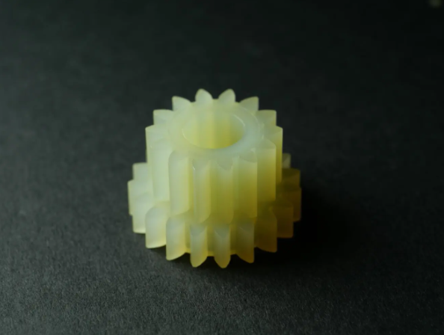
This OA equipment gear requires both heat resistance and low noise performance; therefore, PA (polyamide) was selected as the material. While PA has the characteristic of reduced mechanical strength due to moisture absorption, thorough pre-molding drying treatment was applied to ensure that the material’s inherent rigidity was maintained, enabling successful product realization.
Stopper for Office Automation Equipment (OA Equipment Stopper)
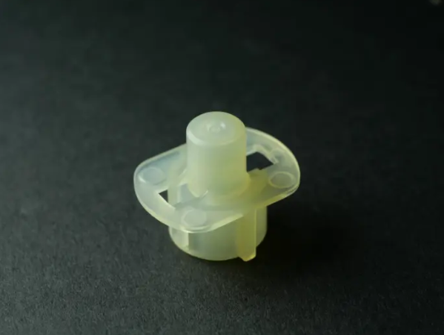
This OA equipment stopper, with dimensions of 16 × 12 × 13 mm, was designed using PA to ensure stable performance under high-load conditions. In order to fully leverage PA’s thermal stability and wear resistance, a fully integrated approach was applied—from material selection through to optimization of molding conditions. As a result, a product was achieved that maintains the required mechanical strength in accordance with design specifications.
Valve for Residential Equipment
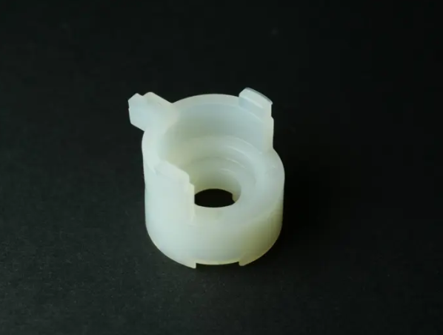
This residential equipment valve component has dimensions of φ20 × 18 mm. It is made of PA, a material with excellent durability but relatively high molding difficulty. By optimizing molding conditions, high dimensional accuracy and excellent flatness were achieved. In particular, sink marks around the O-ring groove were effectively suppressed, resulting in a highly airtight finished product.
Trust us for high-quality PA injection molding
How was it? In this topic, we introduced the characteristics of PA and key points of injection molding. Juraron Industries Co., Ltd. has extensive experience in PA molding and can handle a production volume of 500,000 units per month. Please feel free to contact us.
About JURARON Group
JURARON Group, with its headquarters in Japan, has expanded its branches in Vietnam, Hong Kong, and China. We specialize in the development, production, and sale of precision components,primarily made using injection molding technology. In addition, we provide optical design services, lens injection molding,and the production and processing of ultra-precision molds and components.
Please visit our website for more detailed information about our products and services.