Blogs
2026.07.14
Precision injection molding technologies for achieving High-precision locating bosses
In precision injection molding, locating bosses are critical features that directly determine assembly accuracy and the operational stability of drive components. Especially in small, high-precision parts, even a slight dimensional deviation or warpage can cause assembly defects, backlash (looseness), or operational failure. Therefore, a moldable design that factors in shrinkage and flow behavior is essential. This article covers everything from the applications requiring locating bosses and troubles caused by accuracy failures, to key design points for achieving high-precision locating bosses.
Applications of Small Precision Components Requiring Locating Bosses
A locating boss is a protruding feature designed to align components with high precision. Unlike screw-fastening bosses, its primary role is to fit into a matching hole or recess on the mating part, serving as the reference position during assembly. For small parts manufactured via precision injection molding, even minor dimensional variations can significantly impact product functionality due to their small scale. Therefore, locating bosses require exceptional molding accuracy, which demands careful control over outer diameter dimensions, roundness, post-molding warpage, and structural balance with the surrounding geometry.
Alignment of Drive Components
For drive components such as gears, levers, and pulleys, the relative positioning between interconnected parts directly dictates operational performance. If the dimensional accuracy of the locating boss is unstable, it can cause axis misalignment or component interference. This often leads to poor sliding motion, abnormal noise, and inconsistent operating torque.
Enclosure and Case Components Requiring High Assembly Accuracy
Locating bosses also play a critical role in cases and enclosures used for electronic devices, OA equipment, and industrial machinery. They serve as the reference standard for accurately assembling multiple parts, including the mating of upper and lower cases, securing circuit boards, and aligning internal units.
Defects Occurring Due to Low Accuracy of Locating Bosses
Despite being a minor structural feature, a locating boss significantly impacts the overall assembly accuracy and functionality of the entire product.
Misalignment Occurring During Assembly
If the outer diameter or positional accuracy of the locating boss is inconsistent, the mating position with the counterpart will shift, preventing the parts from aligning correctly during assembly. If the boss is too thick, insertion becomes difficult; if it is too thin, it will cause looseness.
Leading to Malfunctions in Drive Components
If the precision of the locating boss is insufficient in drive components, the reference positions between parts will shift, potentially leading to operational malfunctions. For example, if the meshing position of gears shifts, it can result in increased rotational resistance, abnormal noise, and accelerated wear.
Unstable Dimensions Caused by Sink Marks and Warpage
Since a locating boss is a feature that protrudes from the main body of the product, wall thickness tends to concentrate at its base. If this wall thickness becomes excessive, the cooling shrinkage of the resin increases, making the part highly susceptible to surface sink marks, internal voids, and warpage in the surrounding areas.
Design Points for Achieving High-Precision Locating Bosses
Optimizing Boss Wall Thickness
In the design of locating bosses, optimizing the wall thickness is of primary importance. If the boss wall is too thick, it prolongs cooling time and causes sink marks, warpage, and dimensional variance. On the other hand, if it is too thin, it may lead to insufficient strength or molding defects (such as short shots).Generally, the wall thickness of the boss is designed so that it does not become excessively thick relative to the surrounding nominal wall thickness. In particular, since the base of the boss tends to become thick-walled, it is important to perform core-out or shape adjustments as necessary to achieve a uniform wall thickness.
Suppressing Deformation While Reinforcing with Ribs
When a locating boss requires strength and rigidity, instead of simply increasing its diameter, reinforcing it by utilizing ribs is highly effective. Adding ribs suppresses the tilting or deformation of the boss while avoiding an excessive increase in wall thickness. However, if the ribs are too thick, they can also cause sink marks and warpage. Therefore, the thickness, height, layout, and number of ribs must be properly designed. Balancing multiple ribs around the boss helps maintain even shrinkage during molding, making it easier to stabilize positioning accuracy.
Considering the Draft Angle
In injection molded parts, it is necessary to provide a draft angle to facilitate the ejection of the product from the mold. If the draft angle on a locating boss is insufficient, the boss may deform, or issues like stress whitening and scratch marks may occur during demolding. On the other hand, if the draft angle is too large, the dimensional difference between the tip and the base of the boss increases, which can impact the mating accuracy with the counterpart. Therefore, it is crucial to set an appropriate draft angle while balancing the required locating precision with moldability.
Introduction to Our Processing Examples of High-Precision Locating Boss Molding
Component for OA Equipment
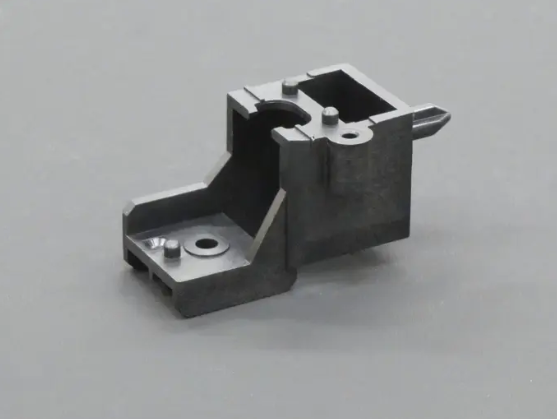
This is an example of injection molding for Office Automation (OA) equipment components. This product is a high-precision part that requires a positional tolerance of φ0.1 or less, and a perpendicularity tolerance of φ0.05 or less for its mounting locating bosses. Since any warpage or deformation in the molded part prevents it from meeting the required accuracy, the window for allowable molding conditions is extremely narrow. Therefore, we utilize multi-stage injection speed control for precise parameter setup and enforce strict management to maintain stable quality
Trust Juraron Industries for Precision Component Injection Molding
In this article, we introduced the precision injection molding technologies required to achieve high-precision locating bosses. At Juraron Industries Co., Ltd., we are equipped with injection molding machines ranging from 15 tons to 100 tons, and possess an extensive track record in molding various small precision components, including precision gears. If you have any challenges or inquiries, please feel free to contact us.
About JURARON Group
JURARON Group, with its headquarters in Japan, has expanded its branches in Vietnam, Hong Kong, and China. We specialize in the development, production, and sale of precision components,primarily made using injection molding technology. In addition, we provide optical design services, lens injection molding,and the production and processing of ultra-precision molds and components.
Please visit our website for more detailed information about our products and services.